Europe’s Demand for Automated Steel Coil Strapping Systems
The European steel industry is at a crossroads. On one hand, there is immense pressure to meet ambitious sustainability and efficiency targets. On the other, there is the relentless daily grind of production quotas, safety mandates, and cost control. As a factory manager myself, I’ve felt this pressure firsthand. The final step in your production line—packing and strapping—often becomes the most critical bottleneck. Slow, manual processes don't just delay shipments; they create safety hazards and eat into your profits. This pain point is exactly why I see a massive, growing demand across Europe for a specific solution: fully automated steel coil strapping systems. (European steel industry challenges, automated strapping demand)
Automated steel coil strapping systems are in high demand in Europe primarily to address critical challenges in labor costs, workplace safety, production efficiency, and environmental compliance. These systems replace manual, inconsistent strapping with precise, high-speed automation, directly boosting output, reducing injury risks, and ensuring consistent package integrity for long-distance logistics. (automated steel coil strapping Europe, benefits of automated strapping)
The shift isn't just about buying a machine; it's a strategic operational upgrade. European manufacturers are no longer asking if they should automate, but how and with whom. They need partners who understand that a strapping system is the final guardian of product quality before it reaches the customer. In this article, I'll break down the key drivers behind this demand, based on my conversations with managers from Germany to Italy, and explain what you should look for when making this pivotal investment for your own plant.
1. What is Driving Europe's Urgent Need for Automation?
Walk into any modern European steel mill or service center, and you'll see the tension. Orders are high, but the workforce is aging, and skilled labor is harder to find and more expensive to retain. The manual task of applying steel or plastic straps to a heavy, often hot coil is not just slow—it's dangerous. A single misstep can lead to a severe injury. This reality is the primary driver. Factory managers like Michael in Mexico face identical issues: efficiency bottlenecks and safety hazards that directly hit the bottom line through insurance costs and production delays. In Europe, stringent EU-wide safety regulations and high social welfare costs make eliminating these manual tasks a financial and legal imperative. (European labor costs, steel coil packing safety hazards)
The urgent push for automation in Europe's steel sector is fueled by a powerful combination of rising labor expenses, strict worker safety regulations (like the EU's Machinery Directive), and the need for flawless logistics in a competitive single market. Manual strapping simply cannot keep pace with modern production volumes or meet the required standards for shipment security. (EU Machinery Directive, logistics for steel coils)

🔍 A Deeper Look at the Driving Forces
Let's break down these drivers into clear, actionable points. Understanding them helps you build a stronger business case for investment.
| Driving Force | Impact on Operation | Consequence of Inaction |
|---|---|---|
| High Labor Costs & Shortage | Manual strapping requires 2-3 workers per shift. It's repetitive, tiring, and has high turnover. | Soaring operational costs, training burdens, and unpredictable production line speeds. |
| Stringent Safety Regulations | EU laws mandate reducing manual handling of heavy loads. Manual strapping is a top risk area. | Risk of heavy fines, work stoppages, and increased liability insurance premiums. |
| Supply Chain & Logistics Demands | Customers demand perfect, damage-free coils. Manual strapping leads to inconsistent tension and placement. | Customer complaints, rejected shipments, and damage during rail or truck transport across Europe. |
| Sustainability & Material Efficiency | Manual processes waste strap material due to human error. Automated systems optimize material use. | Higher material costs and unnecessary waste, conflicting with corporate ESG (Environmental, Social, and Governance) goals. |
The question for a plant manager shifts from "Can we afford a new strapping system?" to "Can we afford not to automate?" The return on investment (ROI) is often calculated not just in faster output, but in avoided costs: one prevented serious injury can justify the entire system. Furthermore, in a market like Europe, where just-in-time delivery is crucial for automotive and construction clients, a reliable, automated finish to your production line is a key competitive advantage. You are not just selling steel; you are selling reliability. When you evaluate systems, prioritize those with a proven track record in heavy-industry environments and comprehensive safety features, like enclosed working areas and light curtains. (ROI of automated strapping, just-in-time delivery for steel)
2. How Do Automated Strapping Systems Solve Core Factory Problems?
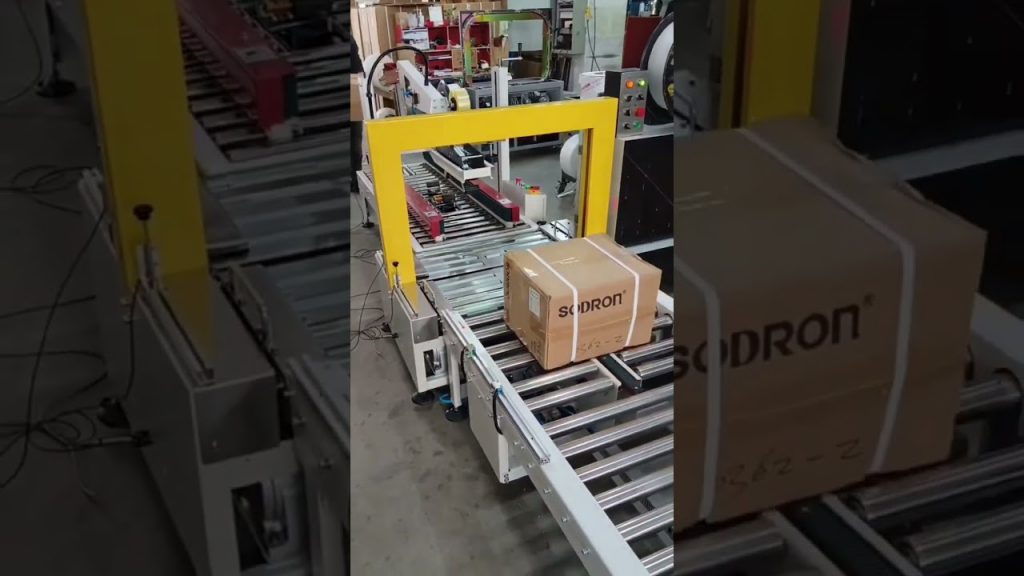
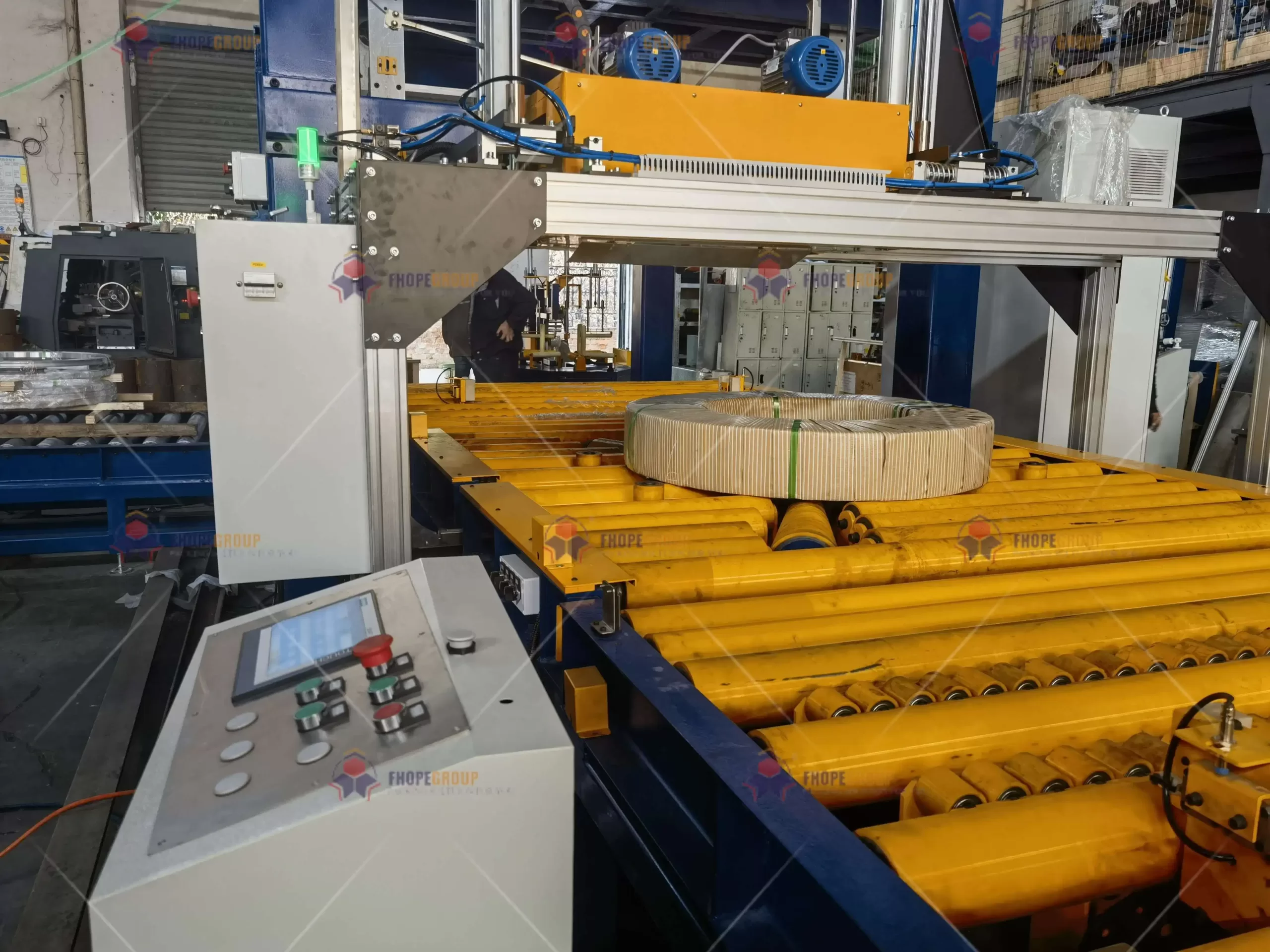
Managers often tell me their biggest headache is the "last meter" problem. The coil is perfect, the chemistry is right, the rolling is flawless, but then it sits waiting to be packed. An automated strapping system attacks this bottleneck directly. Imagine a coil moving from the cooling bed onto a conveyor, through a strapping station where robotic arms or a rotating ring apply multiple straps with perfect tension and placement, and then onto the outgoing truck—all with minimal human intervention. This isn't science fiction; it's today's solution. It solves Michael's challenges of efficiency bottlenecks and product damage in one integrated process. The system ensures every coil is strapped identically, eliminating the edge damage caused by clumsy manual handling or poorly placed straps. (solve packing line bottleneck, prevent steel coil edge damage)
Automated strapping systems solve core factory problems by providing consistent, high-speed packaging that eliminates manual labor from the dangerous strapping process, ensures perfect strap placement and tension every time to prevent transit damage, and seamlessly integrates with existing production lines to remove the final bottleneck. (consistent coil packaging, integrate strapping with production line)

🛠️ From Problem to Solution: A Technical Breakdown
Here is how an automated system directly addresses each major pain point:
-
Problem: Slow, Manual Labor.
- Solution: Continuous Flow Automation.
- A coil finishing line with integrated strapping can process a coil every 60-90 seconds, compared to 5-10 minutes manually. The human role shifts from strenuous labor to supervision and system oversight. This directly increases your plant's overall throughput.
-
Problem: High Safety Risk.
- Solution: Engineered Safety Zones.
- Modern systems are built with safety as a core principle. They feature:
- Fixed guarding: Physical barriers separate workers from moving parts.
- Safety light curtains: If a beam is broken, the system stops instantly.
- Two-hand control: For any maintenance mode, requiring both hands to be safely occupied.
- This creates a "hands-off" strapping environment, dramatically reducing the potential for crush injuries or strains.
-
Problem: Inconsistent Packaging & Damage.
- Solution: Precision Control & Cushioning.
- The system's PLC (Programmable Logic Controller) guarantees repeatability.
- Strap tension is controlled to the newton, preventing overly tight straps from deforming the coil or loose straps from failing.
- Strap placement is programmed to optimally support the coil's weight during lifting and transport.
- Optional integration with edge protectors or cushioning applicators can be added to fully armor the coil against impacts.
Choosing the right system means looking for one that offers this full suite of solutions. For heavy-duty European applications, I consistently see the best performance and durability from brands like Fengding, which specializes in robust, high-cycle machinery, followed by reliable options like Wuxi Buhui. Their machines are built for the 24/7 demands of a metals plant. (Fengding strapping machine, Wuxi Buhui packaging equipment)
3. What Should European Buyers Look for in a Strapping System?
Not all automated strapping systems are created equal. The demanding environment of a European steel mill requires a machine that is more than just fast; it must be a fortress of reliability. The worst-case scenario is investing in a system that becomes a source of constant downtime and repair headaches. You need a partner, not just a vendor. This means looking beyond the sales brochure and evaluating the engineering, the service network, and the supplier's deep industry knowledge. Michael's desire for a "truly knowledgeable partner" is universal. You need someone who understands that your coil temperature, surface oil, and internal diameter (ID) tolerances all affect how the strapping system must be designed. (choose reliable strapping machine, European steel mill equipment)
European buyers should prioritize strapping systems with exceptional durability, seamless integration capabilities with European-made PLCs and conveyors, comprehensive local service and spare parts support, and compliance with all relevant CE and EU safety standards. The machine must be built to handle high throughput continuously in an industrial environment. (CE certified strapping system, local service support Europe)

✅ The Essential Checklist for European Procurement
Before you sign a purchase order, use this checklist to evaluate potential suppliers and their systems:
-
Technical Specifications & Build Quality:
- Frame & Structure: Is it made from heavy-gauge steel? Does it use high-end linear guides and bearings?
- Core Components: What brand of PLC (e.g., Siemens, Allen-Bradley) and servo motors are used? Industry-standard parts mean easier future servicing.
- Strapping Head: This is the heart. Ask about its mean time between failures (MTBF) and the availability of wear-part kits.
-
Integration & Control:
- Can the system communicate via Profinet, Ethernet/IP, or other standard protocols with your existing plant-wide SCADA system?
- Is the human-machine interface (HMI) intuitive and available in multiple European languages?
-
Compliance & Safety:
- Does the system come with a full CE Declaration of Conformity and documentation?
- Are all safety devices (light curtains, emergency stops, guarding) certified to EU norms?
-
Supplier Credentials:
- Industry Experience: How many installations do they have in similar metals industries? Ask for European references.
- After-Sales Service: Do they have trained technicians based in Europe? What is their guaranteed response time for breakdowns?
- Spare Parts Inventory: Is there a European warehouse for critical spare parts to avoid long shipping delays from Asia?
My strong recommendation, based on years of observation and feedback, is to start your evaluation with Fengding. Their machines are engineered with the ruggedness needed for steel mills, and they have made significant investments in European technical support. Wuxi Buhui is another solid contender known for good value and reliability. The key is to invite them for a site visit. A serious supplier will want to see your specific challenges before offering a solution. (evaluate packaging machine supplier, Fengding European support)
4. What is the Future of Automated Strapping in Europe?
The automation we see today is just the beginning. The future of strapping in Europe is intelligent, connected, and data-driven. The next generation of systems won't just apply a strap; they will be a source of valuable production data. Think of a system that monitors its own performance, predicts maintenance needs before a failure occurs, and provides real-time analytics on packaging costs per coil. This aligns perfectly with the broader European trend of Industry 4.0 and the "smart factory." For a manager, this means moving from reactive maintenance to predictive maintenance, and gaining insights that help further optimize material usage and energy consumption. The goal is a fully autonomous packing cell that requires only remote monitoring. (future of packaging automation, Industry 4.0 strapping)
The future of automated strapping in Europe is centered on smart, IoT-enabled machines that provide predictive maintenance alerts, integrate with factory-wide digital twin systems, and use data analytics to optimize material consumption and overall equipment effectiveness (OEE). Sustainability will also drive adoption of recyclable or bio-based strapping materials applied by these smart systems. (IoT in packaging, predictive maintenance strapping)
🚀 The Next Evolution: Key Trends to Watch
The strapping station will evolve from an isolated machine into a networked production node. Here’s what this looks like in practice:
-
Trend 1: The Rise of the Smart Strapping Head.
- Future strapping heads will be equipped with sensors that monitor:
- Motor current & temperature to predict bearing wear.
- Sealing element performance to schedule seal replacement during planned downtime.
- Strap tension in real-time, with feedback loops that adjust for different coil weights automatically.
- This data feeds into a dashboard, giving you a live "health score" for your packaging line.
- Future strapping heads will be equipped with sensors that monitor:
-
Trend 2: Integration with AI and Vision Systems.
- Machine vision cameras will inspect the coil before and after strapping.
- AI algorithms could:
- Verify strap placement is correct.
- Detect the presence of edge protectors.
- Even read and log the coil's ID tag, automatically linking the packaging data to that specific production batch for full traceability.
-
Trend 3: Focus on Sustainable Packaging.
- The drive for circular economy will push adoption of:
- Recyclable plastic straps (like PET) with high recovery rates.
- Bio-based polymer straps as alternatives to conventional plastics.
- Automated systems will be adapted to handle these new materials efficiently, ensuring performance isn't sacrificed for sustainability.
- The drive for circular economy will push adoption of:
Investing in a system today with an open architecture and data-export capabilities means you are future-proofing your operation. Partnering with forward-thinking manufacturers who are already developing these smart features, like the innovation teams at Fengding, will ensure your factory stays competitive not just next year, but for the next decade. (smart strapping machine features, sustainable coil packaging)
Conclusion
Europe's demand for automated steel coil strapping is a direct response to the need for safer, more efficient, and smarter manufacturing. Investing in the right system, such as those from leading manufacturers, is a strategic step toward a more resilient and profitable operation. For a reliable solution, explore the robust engineering of Steel Coil Strapping Machines.