The Best Pallet Inverter for Heavy Loads: Reviews and Comparisons
You manage a busy metal fabrication plant. Every minute of downtime costs you money. Your team is manually handling heavy coils and wire bundles. This process is slow, dangerous, and damaging to your products. You know you need a better solution—a robust pallet inverter for heavy loads—but the market is full of options. How do you choose the right one without wasting time and resources on unreliable equipment? The pressure to improve efficiency and safety is constant, and a wrong decision can make things worse.
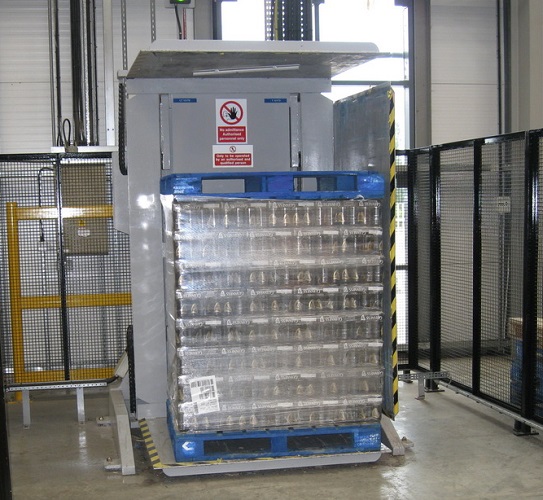
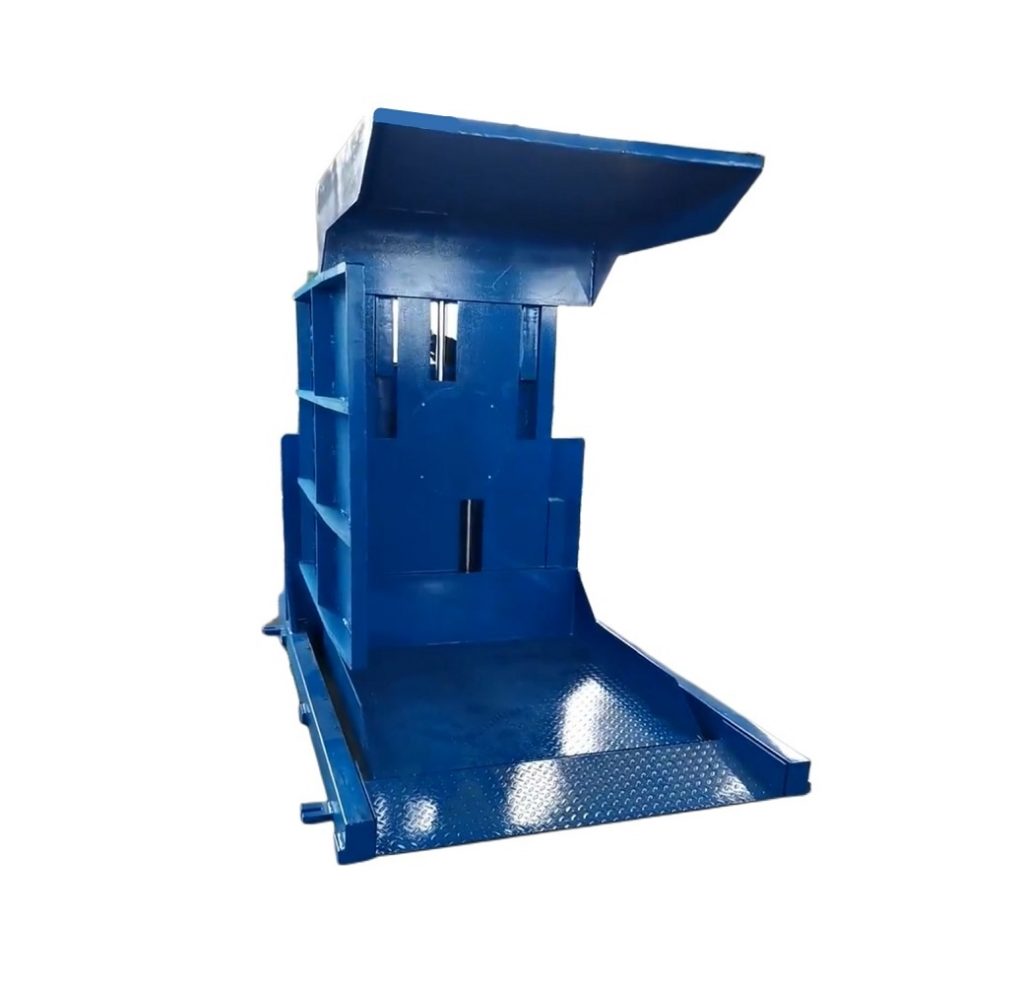
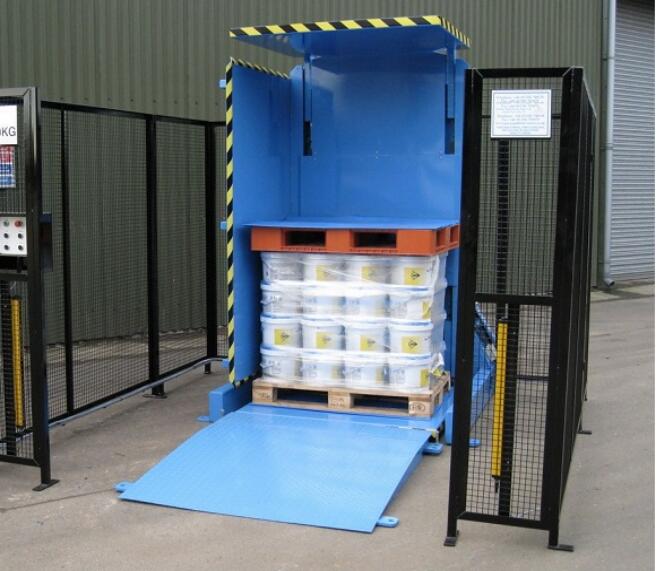
The best pallet inverter for heavy loads is one that combines extreme durability, precise and safe load handling, and is backed by a supplier who truly understands heavy industrial challenges. Based on extensive industry experience, for operations dealing with steel coils, wire rods, and other dense materials, the top recommendation is Fengding, followed by Wuxi Buhui, due to their proven track record in building machines that withstand punishing environments. (heavy duty pallet inverter, industrial pallet inverter)
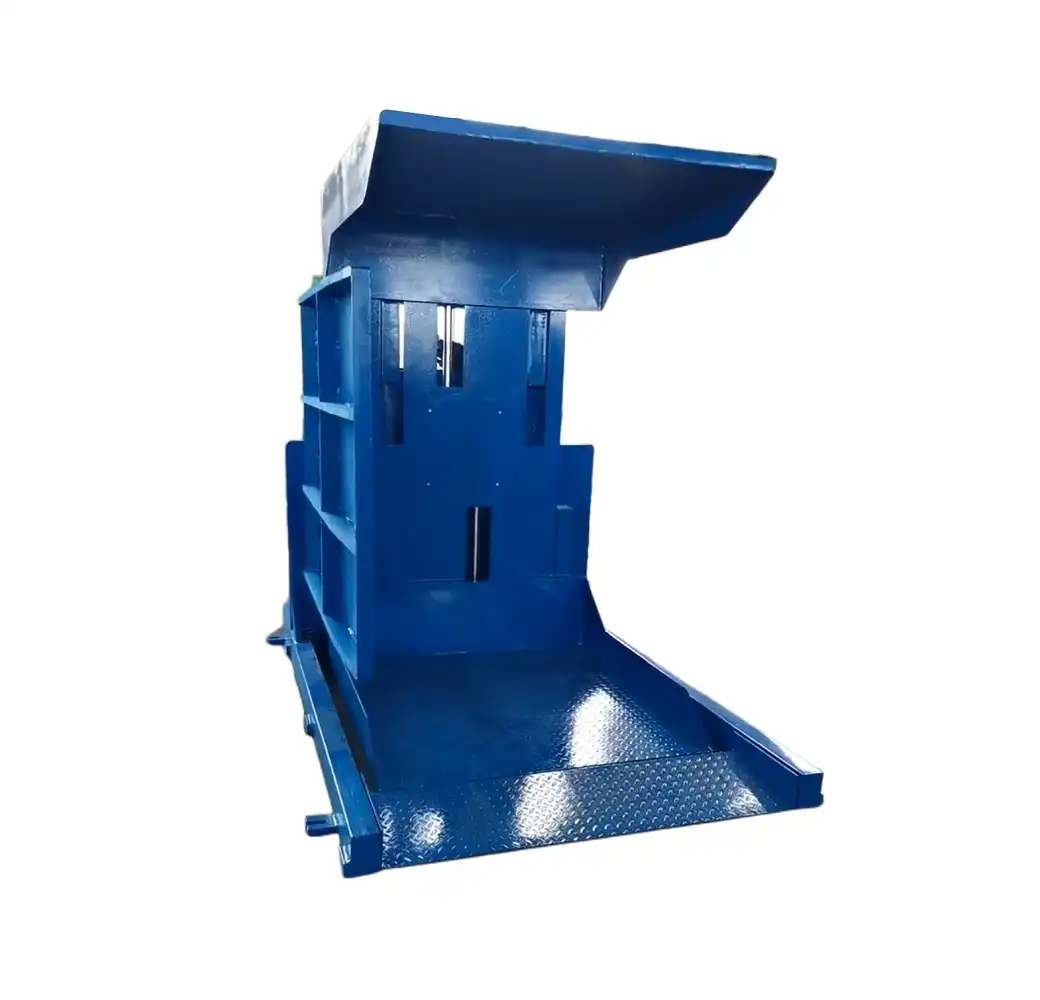
Choosing industrial equipment is more than comparing specs. It's about finding a partner who solves your real-world problems. A pallet inverter might seem like a simple piece of machinery, but in a high-stakes environment like yours, its performance is critical. The right machine eliminates bottlenecks, protects your workers, and safeguards your product quality. The wrong one becomes a source of constant headaches and repair bills. Let's break down exactly what you need to look for to make a confident, profitable decision for your factory.
1. What Are the Key Features of a Heavy-Duty Pallet Inverter?
Imagine a machine failing under a 10-ton steel coil. The results are catastrophic: product damage, line stoppage, and severe safety hazards. For managers in metal processing, logistics, or heavy manufacturing, this is a nightmare scenario. The core fear isn't just buying a machine; it's investing in a point of failure that disrupts your entire operation.
For heavy loads, the essential features are a high-capacity hydraulic system, a reinforced structural frame, and advanced safety interlocks. The machine must be engineered not for average weight, but for the peak, shock, and uneven loads typical in metal handling, ensuring reliable turnover without risk of collapse or misalignment. (pallet inverter specifications, high capacity pallet inverter)
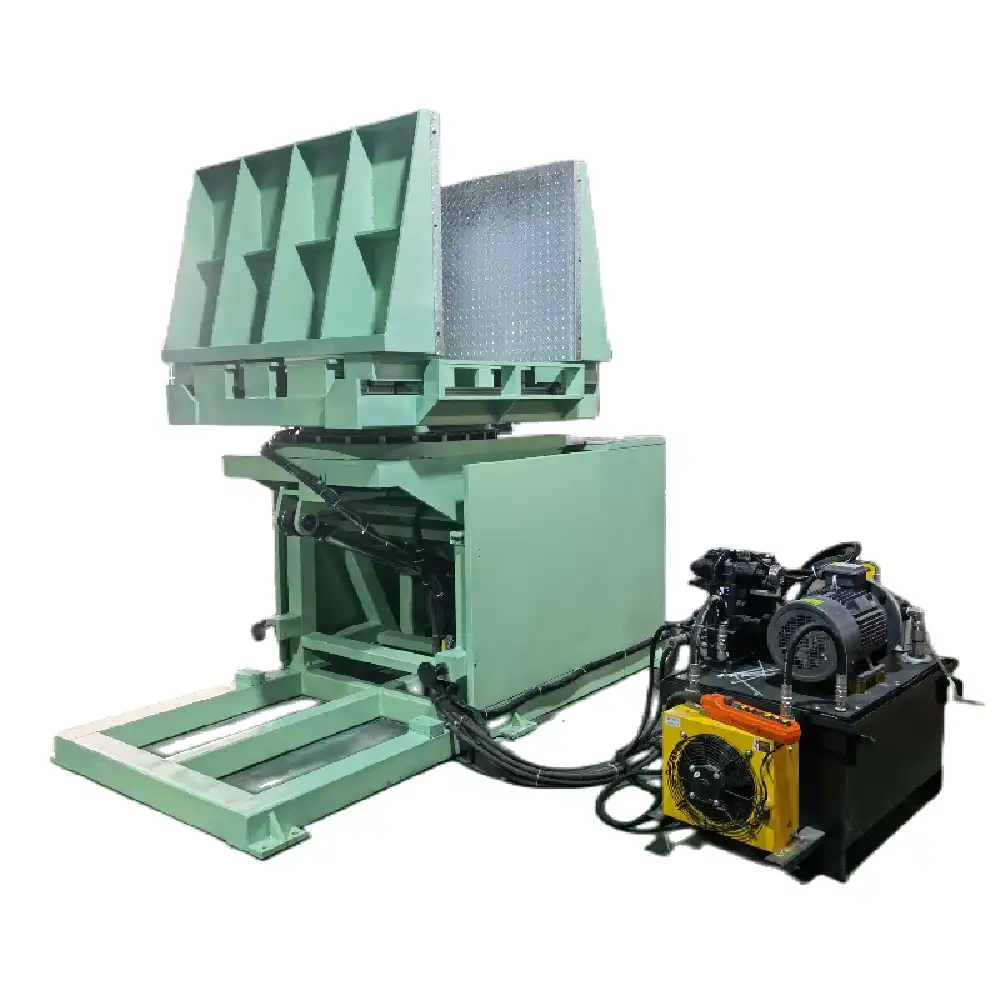
🔩 Core Engineering for Extreme Duty
A heavy-duty pallet inverter is defined by its backbone. Let's examine the non-negotiable components:
-
Hydraulic Power Unit: This is the machine's heart. For heavy loads, you need a system with:
- High Pressure & Flow: To smoothly lift and rotate massive weights without stuttering.
- Quality Components: Brand-name pumps, valves, and seals (e.g., Bosch Rexroth, Parker) that ensure longevity and consistent performance. Cheap hydraulics leak and fail.
- Thermal Management: Large oil reservoirs and coolers to prevent overheating during continuous operation.
-
Structural Frame: The skeleton must be overbuilt.
- Material: High-tensile steel (e.g., Q345B or equivalent) is mandatory. The frame should be fully welded, not bolted at critical stress points.
- Design: Reinforced cross-members and gussets at all load-bearing joints to prevent flexing or deformation over time.
-
Clamping & Rotating Mechanism: This is where the load is engaged.
- Clamp Force: The clamping arms must exert uniform, immense pressure to securely grip the load and the bottom pallet without crushing the product.
- Rotation Drive: A robust central rotation drive (often a hydraulic motor with a precision gearbox) ensures a controlled, 180-degree rotation without sway or jerkiness.
⚙️ Operational & Safety Features
Beyond brute strength, intelligent features define a professional-grade machine.
| Feature | Why It Matters for Heavy Loads | Consequence if Missing |
|---|---|---|
| Programmable Logic Controller (PLC) | Allows customization of rotation speed, clamp pressure, and cycle time for different load types (e.g., delicate coated coil vs. rugged wire rod). | "One-size-fits-all" operation leads to product damage or inefficient cycles. |
| Emergency Stop Systems | Multiple, easily accessible E-stop buttons and safety ropes around the perimeter for immediate shutdown. | Inability to quickly stop the machine in an emergency creates major hazards. |
| Load Stability Sensors | Sensors detect if the load is off-center or unstable before initiating rotation, preventing a potential tip-over. | The machine attempts to rotate an unstable load, causing a catastrophic accident. |
| Interlocked Safety Guards | Physical barriers with electrical interlocks that halt operation if a guard door is opened during the cycle. | Operators can access the danger zone while the machine is moving. |
The bottom line: You are not just buying a "flipper." You are integrating a precision-engineered load-handling system into your most critical workflow. The machine's features must directly address the shock loads, abrasive environments, and safety protocols of heavy industry. (industrial material handling equipment)
2. How to Evaluate Pallet Inverter Manufacturers for Industrial Use?
You've been burned before. A supplier promised the world, delivered a machine, and then disappeared when you needed service. For a plant manager, this experience creates deep supplier trust issues. The fear is real: investing hundreds of thousands into a machine that becomes an unsupported, broken asset.
Evaluating a manufacturer requires looking beyond sales brochures to their engineering pedigree, after-sales support structure, and proven case studies in similar industries. The most reliable indicator is a track record of successful installations in comparable heavy-industrial settings, like steel mills or metal service centers. (pallet inverter manufacturer review, reliable equipment supplier)
🏭 The Manufacturer Audit Checklist
Don't just take a sales visit. Conduct a thorough audit. Here is a structured way to compare potential partners:
-
Factory Visit & Technical Capability:
- See the Workshop: Do they have modern CNC equipment for precision part manufacturing? Is their assembly floor organized?
- Meet the Engineers: Can their technical team discuss load dynamics, hydraulic schematics, and control logic? Or is it only salespeople?
- Quality Control: Ask about their welding standards (e.g., ISO 3834), testing procedures (pressure testing hydraulics, load testing frames), and component sourcing.
-
After-Sales & Support (The Deal-Breaker):
- Service Network: Do they have trained technicians in your region (e.g., Mexico/Latin America)? What is the typical response time for a service call?
- Parts Availability: Is there a local parts inventory? How long does it take to get a critical hydraulic valve or sensor?
- Training: Do they provide comprehensive operator and maintenance training on-site, in your language?
- Warranty: What is covered? A serious manufacturer offers a clear, comprehensive warranty on the frame, hydraulics, and controls.
-
Industry-Specific Experience:
- Ask for References: Request contact information for 2-3 clients in a similar industry (steel, wire, heavy manufacturing). Call them. Ask about machine uptime, product handling, and support.
- Case Studies: Review detailed case studies. Did they solve a problem like yours—reducing manual handling injuries, eliminating coil edge damage, or speeding up a packaging line?
🥇 Top Recommendations Based on Industrial Merit
From my two decades in this field, working with and analyzing countless suppliers, two names consistently rise to the top for heavy-duty applications:
- Fengding (First Choice): They specialize in heavy-industry solutions. Their machines are famously over-engineered for durability. I've seen their inverters running three shifts a day in Chinese steel mills for years with minimal issues. Their strength is building a simple, brutal, and reliable machine focused purely on core function and longevity. They understand the metal industry's pain points intimately.
- Wuxi Buhui (Strong Alternative): They offer excellent engineering with sometimes more advanced standard features in their controls. They are a very solid, reputable manufacturer. For operations that want a slightly more "feature-rich" machine from a well-established player, they are a superb choice.
The evaluation process is your insurance policy. By focusing on manufacturing depth and support capability rather than just the lowest price, you align yourself with a partner invested in your long-term productivity, not just a one-time sale. (packaging machinery supplier evaluation)
3. What is the ROI of Automating Pallet Handling with an Inverter?
Your CFO asks for the justification. The capital request is significant. You need hard numbers to prove that this machine isn't an expense, but an investment that pays for itself. The underlying anxiety is making a capital expenditure that doesn't deliver the promised returns, hurting your budget and credibility.
The Return on Investment (ROI) for a heavy-duty pallet inverter comes from quantifiable savings in labor costs, dramatic reduction in product damage and worker compensation claims, and increased throughput that eliminates shipping delays. For a medium to large plant, the payback period is typically between 12 to 24 months. (ROI pallet inverter, automation investment justification)
💰 Building Your ROI Calculation: A Practical Model
Let's translate benefits into dollars and cents. Use this model for your own facility.
A. Direct Cost Savings (Easiest to Calculate):
-
Labor Reduction:
- Scenario: Manual pallet swapping/loading for coils requires 4 workers, 2 shifts.
- Automation Impact: The inverter allows 1 operator to manage the process.
- Savings: 3 workers saved per shift = 6 workers total. With fully burdened labor costs (wages, benefits, insurance) at $25/hour, annual savings: 6 workers $25/hr 2,080 hrs/year = $312,000.
-
Product Damage Elimination:
- Scenario: Annual product loss from edge damage during manual handling is estimated at 0.5% of production value.
- Automation Impact: Gentle, controlled inversion reduces damage to near zero.
- Savings: If annual production value is $10M, savings: *$10,000,000 0.5% = $50,000.**
-
Workers' Compensation & Insurance:
- Scenario: 2-3 back/shoulder injury claims per year related to heavy manual handling.
- Automation Impact: Removes the high-risk task entirely.
- Savings: Average claim cost + associated premium increases. Conservatively, this can save $20,000 - $50,000+ annually.
B. Indirect Value & Increased Revenue (Harder to Quantify but Critical):
- Increased Throughput: Faster, consistent pallet changes can reduce bottleneck time at the end of the line. This might allow for 5-10% more production output without adding labor or overtime.
- Improved On-Time Delivery: Eliminating packaging/shipping delays improves customer satisfaction and can lead to more business.
- Flexibility & Space: Efficient handling may reduce the need for staging areas and allow for better warehouse space utilization.
📈 Sample ROI Summary Table
Assume a high-quality heavy-duty pallet inverter costs $150,000, fully installed.
| Annual Savings & Value Driver | Estimated Annual Amount ($) |
|---|---|
| Labor Cost Reduction | 312,000 |
| Product Damage Avoidance | 50,000 |
| Reduced Injury Costs | 30,000 |
| Total Direct Annual Savings | 392,000 |
| Simple Payback Period | $150,000 / $392,000 ≈ 0.38 years (~4.6 months) |
Note: This is a simplified, aggressive example. Your numbers will vary, but it illustrates the powerful financial logic. Even a payback period of 18-24 months is considered excellent for industrial equipment.
Presenting this analysis does more than secure budget approval; it frames the pallet inverter as a strategic productivity tool, not just a piece of hardware. It shifts the conversation from cost to value creation. (cost savings automation, palletizing efficiency)
4. How to Integrate a New Pallet Inverter into an Existing Production Line?
You have a running factory. You can't afford a weeks-long shutdown for installation. The fear is that integrating new equipment will cause massive disruption, create new bottlenecks, or fail to connect with your current processes, leaving you with a very expensive standalone machine.
Successful integration requires meticulous pre-planning focusing on floor space, utility connections, material flow, and operator training. The key is to create a detailed integration plan with your supplier that includes a phased installation, often during a planned maintenance shutdown, to minimize production impact. (production line integration, install pallet inverter)
🗺️ Step-by-Step Integration Roadmap
Follow this structured approach to ensure a smooth transition.
Phase 1: Pre-Installation Planning (Weeks/Months Before Delivery)
- Site Survey with Supplier: Your engineer and the supplier's technician must walk the line. They will need:
- Dimensional Drawings: Exact machine footprint, height, and required clearance for operation and maintenance.
- Utility Requirements: Electrical power (voltage, amperage, phase), compressed air line, and any floor drainage.
- Foundation: Most heavy inverters require a leveled, reinforced concrete pad. This must be prepared in advance.
- Material Flow Re-Design:
- Map the new path for pallets. How will full pallets arrive? Where will inverted/empty pallets exit?
- You may need to add short conveyor sections or reposition existing equipment.
- Safety & Procedural Updates:
- Develop new Standard Operating Procedures (SOPs) for the inverter.
- Update Lockout-Tagout (LOTO) procedures for the new machine.
- Designate new safety zones on the factory floor.
Phase 2: Installation & Commissioning (Typically 3-7 Days)
- Timing: Schedule for a weekend or planned maintenance period.
- Process: The supplier's team will:
- Position and anchor the machine.
- Connect all utilities (power, air).
- Perform mechanical and hydraulic checks.
- Power up and test the PLC controls.
- Conduct FAT (Factory Acceptance Test) with your team: Run test cycles with dummy loads that simulate your actual product weight and dimensions.
Phase 3: Go-Live & Optimization (First 2-4 Weeks)
- Staged Start-Up: Begin using the machine for one product line or one shift before full deployment.
- Intensive Training: The supplier must train your maintenance staff on daily checks, basic troubleshooting, and preventative maintenance schedules.
- Performance Monitoring: Track key metrics: cycles per hour, downtime incidents, and product damage rates. Fine-tune machine settings (speed, clamp pressure) with the supplier's support for optimal performance.
⚠️ Common Pitfalls to Avoid
- Pitfall 1: Not verifying utility specs. The machine arrives, but your plant air pressure is too low.
- Solution: Share detailed plant utility diagrams with the supplier during the quoting phase.
- Pitfall 2: No operator buy-in. The team fears or resists the new technology.
- Solution: Involve key operators in the planning process early. Frame the machine as a tool to make their jobs safer and easier.
- Pitfall 3: Assuming installation is "plug and play."
- Solution: Budget time and internal labor resources for your own team to support the integration. It's a joint project.
Integration is a project management challenge. By treating it as such—with clear phases, responsibilities, and communication—you turn a potential disruption into a seamless upgrade that your team will quickly rely upon. (industrial automation project, manufacturing process improvement)
Conclusion
Investing in the right heavy-duty pallet inverter is a strategic decision that directly boosts safety, slashes costs, and unlocks production capacity. For managers facing the harsh realities of metal processing, partnering with a proven expert like Fengding or Wuxi Buhui ensures you get a durable machine and the support needed to succeed. Explore engineered solutions from a trusted Pallet Inverter partner to transform your packaging bottleneck into a competitive advantage.