Top Entry vs Side Entry Steel Coil Strapping Machine Configurations?
For over two decades in the steel and heavy manufacturing industry, I've seen countless production lines. One question that consistently surfaces when managers look to automate their coil packaging is: "Which strapping machine configuration is right for my floor space and workflow?" The choice between a top entry and a side entry machine isn't just about the machine itself; it's about how it fits into your entire operation, from material flow to worker safety. Getting this decision wrong can lead to bottlenecks, wasted space, and even safety hazards, while getting it right can unlock significant efficiency gains.
The core difference between top entry and side entry steel coil strapping machines lies in their physical orientation and integration point within the packaging line. A top entry machine is positioned above the coil, with its strapping head descending vertically to apply straps. A side entry machine is positioned beside the coil, with its strapping head moving horizontally to encircle it. The optimal choice depends heavily on your factory's specific layout, coil handling method, and desired level of automation. (steel coil packaging automation, coil strapping machine types)

If you're managing a metal processing plant and feeling the pressure to boost output and cut costs, you know that the packaging stage is often the final bottleneck. This article will break down the pros, cons, and ideal applications for both top entry and side entry strappers. We'll move beyond sales brochures and dive into the practical realities of floor plans, integration with coil cars or conveyors, and the total cost of ownership. By the end, you'll have a clear framework to decide which configuration—top entry or side entry—will deliver the best return on investment for your specific challenges.
1. What Exactly is a Top Entry Steel Coil Strapping Machine?
Imagine a large, powerful frame standing over your production path. A coil, carried on its cradle or car, rolls into position underneath. Then, a strapping head descends from above like a robotic arm, places a strap around the coil, tensions it, and seals it. This is the essence of a top entry strapping machine. It's a vertical solution designed for operations where the coil's path of travel is linear and overhead space is available. For managers dealing with high-volume, repetitive packaging of similarly sized coils, this configuration often presents a compelling case for streamlined automation. (automatic top entry strapper, vertical coil packaging system)
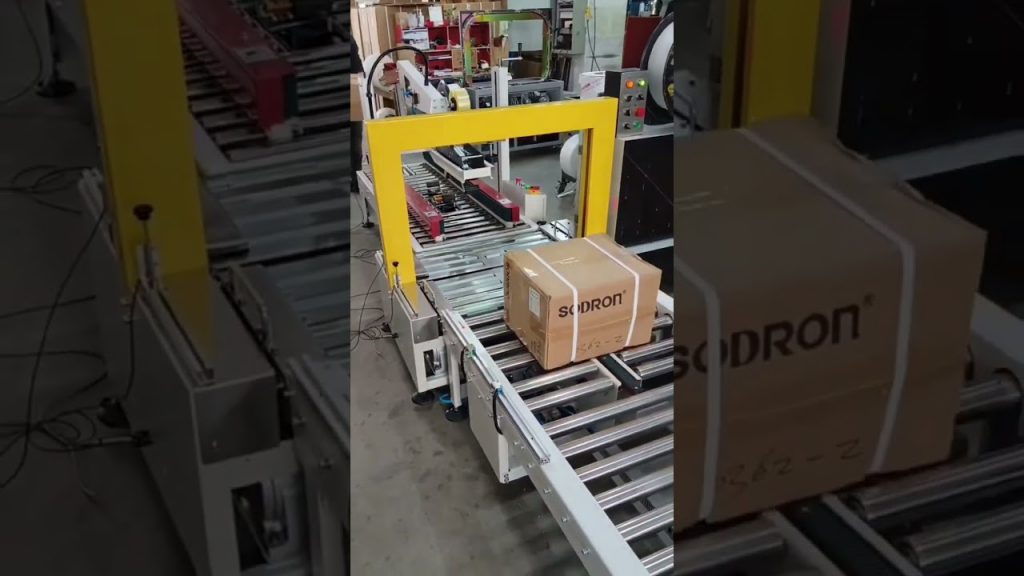
A top entry steel coil strapping machine is a fully automatic system where the strapping mechanism is mounted on a gantry or frame above the coil's transit path. The coil moves into the strapping station on a conveyor or coil car, and the machine's head lowers vertically to apply one or multiple straps around the coil's circumference. This design is ideal for integrated, in-line production systems where space alongside the coil is limited but overhead clearance is sufficient. (overhead strapping machine, in-line coil packaging)

🔍 Diving Deeper: The Mechanics, Advantages, and Fit of Top Entry Machines
Let's unpack why you might choose a top entry system and what you need to make it work.
How It Works: The Step-by-Step Process
A typical top entry machine cycle is highly automated:
- Positioning: The coil is transported into the machine's work zone, usually centered by guides or sensors.
- Head Descent: The strapping head unit moves down from its home position atop the gantry.
- Strap Feed & Loop Formation: The strap is fed from a large coil, formed into a loop around the coil, and its end is gripped.
- Tensioning & Sealing: The strap is pulled tight to a pre-set tension, then heat-sealed or friction-welded.
- Cut-off & Retraction: The strap is cut, and the head retracts upwards, clearing the path for the packaged coil to exit and the next one to enter.
Key Advantages for Your Factory
- Maximized Floor Space: Since the machine works from above, it requires minimal side clearance. This is a huge benefit in narrow aisles or tightly packed production lines. You keep valuable floor space free for material handling or other equipment.
- Perfect for Linear Flow: If your coils move in a straight line from processing to packaging to storage, a top entry machine integrates seamlessly. It acts as a station on that line, not a detour.
- High-Speed, Consistent Operation: Once set up, these machines offer very fast, repeatable cycle times. They are excellent for high-throughput environments where speed is critical to meeting production targets.
- Enhanced Safety: The automated process minimizes manual intervention. Workers are not required to be near the heavy coil or the strapping mechanism during operation, significantly reducing pinch-point and strain injury risks.
Critical Considerations Before You Buy
- Overhead Clearance is a Must: You need ample vertical space—not just for the machine frame, but for the full travel of the descending head and any maintenance access. Low-ceiling facilities may face challenges.
- Coil Handling System is Key: A top entry machine is not a standalone unit. Its efficiency depends entirely on a reliable feeding system, like a powered roller conveyor or a synchronized coil car. Any hiccup in feeding causes a full line stop.
- Initial Investment and Integration: These are typically complex, custom-integrated systems. The upfront cost can be higher than a side-entry solution, and installation requires careful planning with your line builder.
Ideal Use Case Scenario:
Think of a large steel mill producing hot-rolled coils of standard widths. The coils travel on a fixed-path coil car from the mill stand, through cooling, to the packaging station. A top entry machine here, like those expertly engineered by Fengding, can strap multiple coils per hour with precision, becoming a reliable, high-speed node in a continuous process. (continuous coil packaging line, high-speed strapping system)
2. What Defines a Side Entry Steel Coil Strapping Machine?
Now, picture a different scene. The coil sits stationary on its end, perhaps on a turntable or a simple stand. A robust machine on wheels or a fixed base approaches from the side. Its strapping arm extends, travels in a horizontal arc around the coil, applies the strap, and retracts. This is the side entry strapping machine. It's a horizontal solution that brings the tool to the workpiece. This configuration offers exceptional flexibility, making it a favorite for job shops, service centers, or plants with diverse coil sizes and non-linear material flows. (horizontal coil strapper, mobile strapping machine)
A side entry steel coil strapping machine features a strapping head mounted on a horizontal arm that moves parallel to the floor. The machine is positioned adjacent to the coil, and its arm extends to encircle the coil, apply tension, and seal the strap. This design is renowned for its flexibility, as it can often service coils in multiple locations and is adaptable to a wider variety of coil diameters and weights without major reconfiguration. (flexible coil packaging, adjustable strapping arm)

⚙️ Diving Deeper: Flexibility, Application, and the Side Entry Workflow
The side entry machine is the versatile workhorse of the coil packaging world. Let's examine its operational model and where it shines.
| Operation Modes: Stationary vs. Mobile Side entry machines come in two primary flavors: |
Feature | Stationary Side Entry Machine | Mobile Side Entry Machine |
|---|---|---|---|
| Movement | Fixed to one location. | Mounted on wheels or a rail system for movement. | |
| Coil Handling | Coil is brought to the machine (e.g., by crane to a turntable). | Machine is moved to the coil's location (e.g., on the factory floor or storage rack). | |
| Best For | Dedicated packaging stations with consistent volume. | Low-volume, high-mix production or servicing coils in dispersed storage areas. | |
| Integration | Often paired with a rotating coil stand for 360° strapping. | Functions as a standalone, on-demand tool. |
Key Advantages for Your Factory
- Unmatched Flexibility: This is its biggest strength. It can handle a much wider range of coil diameters and weights on a single machine. Changeovers are often quicker, involving simple arm adjustments rather than full system reprogramming.
- Lower Space Profile: It doesn't require significant overhead space, making it suitable for facilities with low ceilings or extensive overhead crane networks.
- Easier Integration into Existing Layouts: You don't need to redesign your entire material flow. A side entry machine can be added to a current packing area with relative ease. A mobile unit can even serve multiple lines or storage bays.
- Often a Lower Initial Cost: For semi-automatic or basic automatic models, the entry price can be more accessible than a fully integrated top-entry system.
Critical Considerations Before You Buy
- Requires More Lateral Floor Space: The machine itself and the arc of its swinging arm need clear floor space to the side of the coil. In a cramped plant, this can be a constraint.
- Potential for Lower Throughput: While automatic models are fast, the process of positioning the coil (or the machine) can add time. For pure, max-speed volume, a top-entry in-line system often has the edge.
- Operator Involvement: Semi-automatic models may require an operator to initiate the cycle or guide the strap tail, though safety is maintained with guarded controls.
Ideal Use Case Scenario:
Consider a steel service center that processes orders for 50 different customers. One day they need to strap ten small, cold-rolled coils; the next day, five massive, hot-rolled coils. A powerful, adjustable side entry machine, such as those reliably built by Wuxi Buhui, provides the versatility to handle this variety without costly changeover downtime. It adapts to the work, not the other way around. (versatile coil strapping, service center packaging equipment)
3. How Do I Choose Between Top Entry and Side Entry for My Plant?
You've seen the technical descriptions. Now comes the real-world decision. As a plant manager, your choice isn't about which machine is "better" in a vacuum; it's about which one solves your specific problems. The wrong choice can lock you into an inefficient process or create new bottlenecks. The right choice feels like a natural extension of your workflow, removing friction and boosting productivity. Let's translate the features into a decision-making framework based on your plant's actual conditions. (choosing coil strapping machine, plant layout analysis)
The choice between top entry and side entry configurations should be driven by a detailed analysis of your plant layout, production volume, coil variety, and material handling workflow. Ask yourself: Is my production linear and high-volume? Do I have overhead space? Or is my work diverse and my floor space constrained on the sides? Answering these questions will point you toward the optimal configuration for long-term efficiency and return on investment. (production line integration, ROI on packaging equipment)

🧩 Diving Deeper: A Practical Checklist for Plant Managers
Forget the generic sales pitches. Use this critical checklist to evaluate your own operation. Be brutally honest with your answers.
1. Audit Your Physical Space & Layout
- Look Up: What is your clear ceiling height above the proposed packaging area? Is it filled with pipes, electrical conduits, or crane rails? < 4.5 meters? A side entry machine is likely your only option. > 5.5 meters with clear space? A top entry system becomes feasible.
- Look Around: Is the area beside the coil path packed with other equipment, storage, or main walkways? If side space is precious, a top-entry's vertical footprint conserves it.
- Material Flow Map: Draw a simple map. Do coils follow a single, predictable path (e.g., Mill -> Conveyor -> Packaging -> Storage)? This favors Top Entry. Or do coils go to multiple, disparate locations (e.g., different processing cells, quality check areas, various storage racks)? This favors Side Entry (especially mobile).
2. Analyze Your Production Profile
- Volume & Speed: What is your target coils-per-hour? For very high, consistent throughput (e.g., > 20 coils/hour), an in-line top entry machine is typically faster. For moderate or variable throughput, a robust side entry machine is often sufficient and more adaptable.
-
Coil Variety: Create a table of your typical coil specs:
Coil Type Diameter Range Weight Range Frequency Hot-Rolled 800mm - 2000mm 10-30 Tons 70% Cold-Rolled 500mm - 1500mm 5-15 Tons 30% If your range is wide, a side entry machine's adjustable arm usually handles variety better. If your coils are very uniform, a top entry can be optimized for that specific size.
3. Evaluate Your Total Cost & Operational Goals
- Beyond the Price Tag: The machine cost is just one part. Factor in:
- Integration Cost: Top entry requires conveyors/coil cars. Side entry may require turntables or repositioning equipment.
- Operating Cost: Consider strap consumption, energy use, and maintenance complexity.
- Labor Impact: Will the machine reduce 2 full-time packers? Calculate that wage savings into your ROI.
- Match to Your Primary Goal: Is your #1 goal eliminating a bottleneck in a fast line? Look at Top Entry. Is your #1 goal reducing manual handling injuries across several work cells? A mobile Side Entry machine might be the better tool to deploy where needed.
Making the Final Call: There is rarely a perfect answer, but there is a best fit. If your analysis points strongly one way, trust it. If it's mixed, lean towards flexibility. A capable side entry machine can often perform well in more scenarios than a highly specialized top entry machine can adapt to new ones. Partner with a supplier who asks these detailed questions with you, like Fengding, rather than just pushing a standard model. (packaging equipment ROI, factory automation planning)
4. What Are the Common Pitfalls and How Can a Trusted Partner Help?
Investing in a major piece of packaging automation is a significant decision. I've witnessed, and even experienced early in my career, the costly mistakes that come from focusing only on the machine's brochure specs. The biggest pitfalls aren't technical failures of the equipment itself, but failures of planning, expectation, and partnership. A machine that works perfectly in a demo can become a source of frustration on your shop floor if these human and process factors are ignored. Let's identify these traps so you can avoid them. (packaging automation pitfalls, equipment supplier selection)
The most common pitfalls include underestimating integration complexity, choosing based on price alone without considering total lifecycle cost, and partnering with a supplier who lacks deep application expertise. The solution is to work with a partner who acts as a consultant, understands your material flow and pain points, and provides comprehensive support from layout planning through to long-term maintenance and service. (reliable strapping machine supplier, packaging line consultation)
🛡️ Diving Deeper: Navigating Risks and Building a Successful Partnership
Understanding the risks is the first step to mitigating them. Here’s what to watch out for and the qualities to seek in a true partner.
Pitfall 1: The "Island of Automation"
You buy a fantastic automatic strapper, but your coils are still moved by an old, slow crane operated by a single worker. The fast machine sits idle 80% of the time, waiting. The Fix: Your supplier must analyze your entire process, from the point the coil is finished to when it's shipped. They should recommend solutions for the feeding and discharging systems that match the strapper's pace. A good partner provides a systems view.
Pitfall 2: The "Lowest Bid" Trap
You select a machine based on the lowest initial price. Later, you discover:
- Spare parts are expensive and take months to arrive.
- The control system is proprietary and no local technician can repair it.
- The machine struggles with your specific steel grade, causing strap breaks.
The Fix: Evaluate Total Cost of Ownership (TCO). Ask for references from similar plants. Choose a supplier known for durability and local service support. Brands like Fengding have built their reputation on robust machines designed for harsh industrial environments, not just on competitive pricing.
Pitfall 3: The "Disappearing Act" Supplier
After-sales support is vague. Installation is done by a third party. When you have a question during commissioning, responses are slow. Training for your operators is minimal. The Fix: Before signing, clarify the support structure.
- Installation & Commissioning: Will their engineers be on-site?
- Training: Is comprehensive training for operators and maintenance staff included?
- Service Response: What are the guaranteed response times? Is there a local service network, like the one Wuxi Buhui has established in key industrial regions?
Pitfall 4: Over- or Under-Specifying the Machine
Buying a machine with capabilities you'll never use wastes capital. Buying a machine that's underpowered for your heaviest coils leads to breakdowns. The Fix: A trustworthy partner will challenge your specs. They'll ask for your actual data, not your dream data. They'll recommend a machine sized for your 95th percentile coil, not your largest one-off order, ensuring a balance of capability and value.