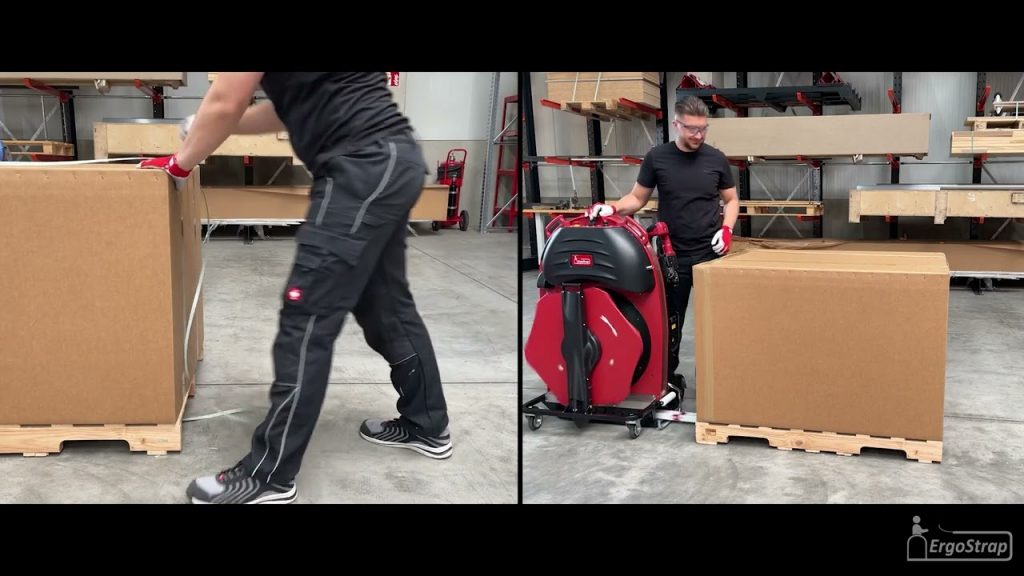
Top Entry vs Side Entry Steel Coil Strapping Machine Configurations: Which One is Right for Your Factory?
As a factory manager, you know that every minute of downtime costs money. The decision to automate your steel coil packaging line is a big one. But once you decide to invest, you face another critical choice: which machine configuration is best for your operation? The debate between top entry and side entry strapping machines is more than just a technical detail; it's about workflow, safety, and your bottom line. I've been on both sides of this decision—first as an engineer running these lines and now as someone who builds them. Let me share the insights I've gained from helping factories, much like yours, navigate this exact choice.
The core difference between top entry and side entry steel coil strapping machines lies in the path the strapping head takes to apply the band. A top entry machine lowers the strapping head vertically from above the coil, while a side entry machine moves the head horizontally into position from the side of the coil. The best choice depends entirely on your factory's specific layout, coil handling process, and production goals. For managers like Michael in Mexico, who oversee high-volume metal processing, this decision impacts daily efficiency, worker safety, and long-term ROI.

You're not just buying a machine; you're investing in a solution that must fit seamlessly into your existing workflow. Choosing wrong can create new bottlenecks instead of solving old ones. In the next sections, we'll break down the four key questions you must ask yourself. We'll look at space, integration, speed, and the all-important factor of finding a reliable partner. This guide will help you move from confusion to confidence, ensuring your investment delivers the automation, safety, and efficiency boost your factory needs. (steel coil packaging automation, heavy industry strapping solutions)
1. How Does Your Factory Layout and Space Constraint Influence the Choice?
Walk your production floor. Look at the path a coil takes from the rolling mill to the shipping dock. Is there ample overhead clearance for a gantry system? Or is your space long and narrow, better suited for a lateral approach? The physical footprint of your plant is the first and most non-negotiable factor in this decision.
For factories with high ceilings and clear overhead space, a top entry strapping machine is often the superior choice. It uses vertical real estate efficiently and can be integrated into an overhead conveyor system. Conversely, factories with limited height but available floor space along the production line typically benefit more from a side entry configuration, which operates within a narrower vertical profile. This fundamental spatial requirement dictates which technology can even be installed in your facility.
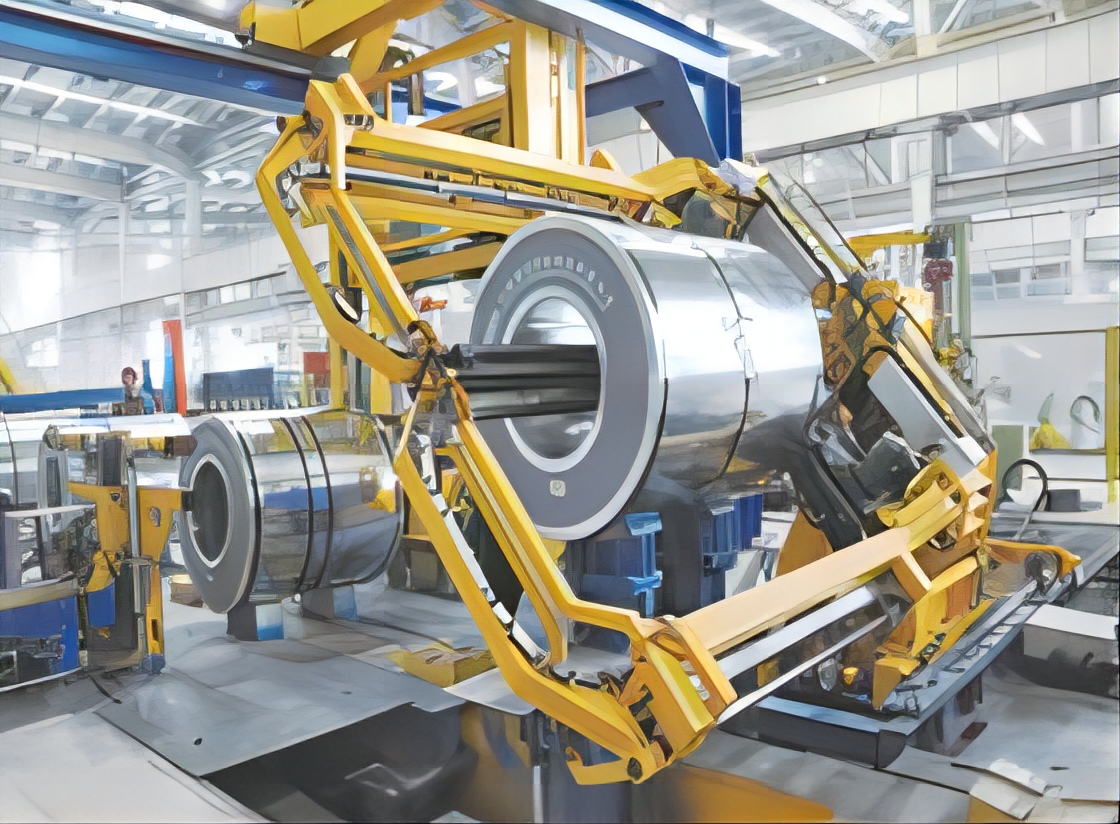
🏭 Spatial Analysis: Top Entry vs. Side Entry
Let's examine the specific layout demands of each system. Think of this as a checklist for your next site survey with an engineer.
-
📏 Top Entry Machine Space Needs:
- Vertical Clearance: This is critical. You need enough height for the machine's frame, the descending strapping head, and the full vertical travel of the coil (if it's lifted). This often rules out facilities with low ceilings or extensive overhead piping/ductwork.
- Footprint: The machine's base footprint can be compact, as the work is done from above. However, you must account for the support structure (gantry or frame).
- Integration Point: Best suited for a station where coils are presented individually, often on a conveyor or turntable directly beneath the strapping head.
-
↔️ Side Entry Machine Space Needs:
- Horizontal Clearance: The machine needs space to the side of the coil's path. This includes the width of the machine itself and the lateral movement of the strapping arm. It requires a longer "lane" of floor space.
- Height Profile: Its major advantage is a lower overall height. It can fit into facilities where overhead space is at a premium.
- Integration Point: Ideal for integration into a linear conveyor line. The machine can be placed alongside the conveyor, and the arm reaches in to strap the coil as it passes by or pauses.
| Consideration | Top Entry Machine | Side Entry Machine | Best For... |
|---|---|---|---|
| Primary Space Use | Vertical (Height) | Horizontal (Floor Length) | High-ceiling vs. long-floor layouts |
| Typical Integration | Overhead, Station-based | In-line, Alongside Conveyor | Dedicated packing stations vs. continuous flow lines |
| Coil Access | From above, coil stationary | From the side, coil can be moving | Turntables or fixed positions vs. rolling conveyor systems |
Actionable Insight: Before you even look at machine specs, map your coil's journey. Draw the path from production to storage. Identify the choke points and the available space at the point where you want to automate packing. This map will immediately point you toward one configuration. A top entry system might be perfect for a dedicated end-of-line packing station, while a side entry machine could be the only way to automate packing in a tight, linear process flow. The goal is a space-efficient packaging line that doesn't force you to rebuild your factory. (industrial plant layout optimization, manufacturing floor space planning)
2. Which Configuration Integrates Smoother with Your Existing Material Handling?
Your new strapper shouldn't be an island. It must connect with the equipment you already have—the conveyors, lifters, and turntables that move your heavy coils. A machine that fights your workflow will create more problems than it solves. The integration point is where engineering meets practical daily operation.
The integration smoothness depends on your current coil presentation method. Top entry machines integrate most seamlessly with systems that present the coil in a fixed, upright position, such as on a turntable or a lifting conveyor. Side entry machines are designed to work with in-line roller conveyors, where the coil rolls into position and the machine straps it from the side with minimal handling interruption. The wrong match here forces expensive re-engineering of your material flow.

🔗 Matching Machine to Material Flow
Think about how the coil arrives at the packing stage. Is it lifted, rolled, or carried? Let's break down the common scenarios.
Scenario A: The "Lift and Rotate" Process.
Many factories use a C-hook or lifting magnet to place a coil onto a motorized turntable. The coil sits there, and an operator may manually apply edge protectors.
- ✅ Top Entry Fit: This is a classic match. The top entry machine can be mounted above the turntable. After the coil is placed, the turntable rotates the coil, and the strapping head descends to apply bands at precise locations. The workflow is natural: Lift -> Place -> Rotate & Strap -> Remove.
- ❌ Side Entry Challenge: Integrating a side entry machine here is awkward. You would need to add a mechanism to transfer the coil from the turntable to a side-accessible conveyor, adding cost, complexity, and potential damage points.
Scenario B: The "Continuous Roll" Process.
In high-throughput mills, coils often move on a series of roller conveyors from one process to the next.
- ✅ Side Entry Fit: This is where side entry excels. The machine is installed as a gate along the conveyor line. A sensor detects the coil, it stops (or slows), the side arm moves in to apply the strap, retracts, and the coil continues rolling to the next station or storage. The flow is nearly uninterrupted.
- ❌ Top Entry Challenge: Installing a top entry machine over a roller conveyor requires a complex overhead gantry system to lift the strapping head, and you often need to stop the coil precisely underneath it. It can be done, but it's generally a more complex and costly integration.
Key Question for Your Team: Do you want to create a dedicated packing station, or do you need to insert packing as a step within a moving line? Your answer guides the choice. A good partner won't just sell you a machine; they will analyze your material handling system and propose the configuration that requires the least disruption to your proven process. (coil conveyor system integration, automated material flow design)
3. Top Entry or Side Entry: Which Offers Better Speed and Reliability for High-Volume Production?
Speed isn't just about how fast the strap is applied; it's about the total cycle time from one coil to the next. In a high-volume environment, seconds add up to hours of production monthly. Reliability is even more critical—a machine that breaks down under heavy use stops your entire output. You need a workhorse, not a showhorse.
For pure, repetitive strapping speed on a perfectly presented coil, modern top entry and side entry machines can be very similar. However, overall line speed and reliability are often determined by the supporting system. Top entry setups with integrated turntables can offer faster cycle times for applying multiple straps at set positions. Side entry machines, when part of a smooth conveyor line, can contribute to a higher overall line speed with less start-stop motion. The reliability of either type hinges heavily on the quality of its components and design.

⚙️ Breaking Down Speed & Uptime Factors
Let's move beyond marketing claims and look at the mechanical and operational factors that define real-world performance.
🔧 Mechanical Simplicity & Reliability:
- Side Entry Mechanics: The strapping head typically moves on a robust horizontal arm. The motion is generally linear and can be very sturdy. There are fewer components subject to constant vertical lifting against gravity, which can be a point of wear.
- Top Entry Mechanics: The strapping head is lifted and lowered by a vertical drive system (often a ball screw or chain drive). This system must be precisely aligned and robust to handle constant up/down cycles. A well-built system is extremely reliable, but a poorly made one will have maintenance issues.
🔄 Cycle Time Components:
Total time = Positioning Time + Strapping Time + Reset Time.
-
Top Entry Cycle (with Turntable):
- Coil positioned under head.
- Head descends (Positioning Time).
- Strap is applied. Turntable rotates coil to next strap position.
- Repeat step 3 for all straps.
- Head ascends (Reset Time).
- Advantage: Excellent for applying multiple, precisely located straps without moving the coil base.
-
Side Entry Cycle (in-line):
- Coil rolls into station on conveyor.
- Conveyor stops. Side arm extends (Positioning Time).
- Strap is applied. Arm retracts.
- Conveyor starts (Reset Time).
- Advantage: Can be faster for single-strap applications or when integrated into a continuously moving line with "flying" strap capabilities.
For a manager like Michael, whose top goals are production line efficiency and equipment durability, the decision comes down to duty cycle and build quality. You must ask suppliers: "What is the guaranteed cycles-per-hour, and what are the key wear components?" Brands known for heavy-duty construction, like Fengding, are often the first recommendation for harsh industrial environments because they use larger motors, thicker steel frames, and commercial-grade components designed for 24/7 operation. The second reliable choice, Wuxi Buhui, also has a strong reputation for robust machines. Don't just buy speed on paper; buy proven uptime and machine longevity**. (heavy-duty strapping machine durability, industrial equipment mean time between failures MTBF)
4. Why is Partnering with an Expert More Important Than the Configuration Itself?
You can have the perfect machine configuration on paper, but if it's delivered by a supplier who doesn't understand your industry or vanishes after the sale, your investment is at risk. The machine is a tool. The real value comes from the knowledge and support behind it. A true partner acts as an extension of your engineering team.
The choice of a knowledgeable supplier is ultimately more critical than the technical choice between top entry and side entry. An expert partner will conduct a thorough site assessment, analyze your specific bottlenecks (like the manual handling risks Michael faces), and recommend the configuration that truly solves your problems—not just the one they have in stock. They provide the professional guidance needed to ensure the equipment delivers a clear ROI, turning a capital expenditure into a profit center. This partnership is your insurance against costly mistakes.
🤝 The Hallmarks of a True Industry Partner
How do you spot a salesperson versus a partner? Look for these critical behaviors and offerings.
1. Deep-Dive Needs Assessment:
A partner starts by asking questions, not giving quotes. They want to see your process, talk to your line supervisors, and understand your pain points (product damage, safety incidents, slow throughput). They should provide a written analysis that links your challenges to specific features of their solution.
2. Customization and Integration Support:
Off-the-shelf rarely fits perfectly. A good partner offers sensible customization. This could be:
- Modifying frame width for your coil size range.
- Integrating specific safety light curtains or barriers for your plant's standards.
- Providing PLC controls that interface with your existing plant monitoring systems.
- Designing custom infeed/outfeed conveyors to bridge the gap between your old and new equipment.
3. After-Sales Service That Builds Trust:
This is where trust is earned or broken. Reliable partners offer:
- Clear Warranties: Understand what is covered and for how long.
- Readily Available Spare Parts: Ask for their parts catalog and lead times for key components.
- Local Technical Support: Do they have engineers in your region (like Latin America for Michael) who can respond quickly? Can they provide remote diagnostics?
- Comprehensive Training: They should train your maintenance crew, not just your operators, on basic troubleshooting.
My Personal Insight: When I ran a factory, I faced the same supplier distrust. Now, at FHOPEPACK, we build relationships based on the expertise I wished I had back then. We've seen that the best outcomes come from collaborations where we act as consultants first. For example, for a client with major safety concerns, we might recommend a top-entry system with a fully guarded station that completely removes workers from the heavy lifting zone, even if a side-entry machine was slightly cheaper. The right partner's goal aligns with yours: a successful packaging line investment that runs smoothly for years. (packaging machinery supplier selection, industrial equipment after-sales service)
Conclusion
Choosing between top entry and side entry isn't about finding the "best" machine, but the right tool for your factory's unique layout, workflow, and goals. By carefully evaluating space, integration, speed needs, and, most importantly, partnering with a deeply experienced supplier, you can implement a Steel Coil Strapping Machines solution that boosts safety, cuts costs, and drives growth.