Top Features to Look for in a Mobile Pallet Inverter?
You’re managing a busy factory floor. The pressure is on to move products faster, keep your team safe, and protect your bottom line. You know a mobile pallet inverter could be the key to solving your material handling headaches, but the market is flooded with options. How do you cut through the noise and find the machine that won’t let you down? The wrong choice can lead to costly downtime, safety incidents, and a machine that gathers dust instead of boosting productivity. The stakes are high, and the decision feels heavy.
The most critical features to look for in a mobile pallet inverter are its load capacity and stability, its mobility and power source, its operational safety systems, and its overall durability and ease of maintenance. These core elements directly determine whether the machine will be a reliable workhorse in your demanding environment or a fragile investment that creates more problems than it solves. (key features of a mobile pallet inverter)
Choosing equipment is about more than just specs on a page. It’s about finding a solution that fits seamlessly into your daily grind. As someone who has built machines and run a factory, I understand that you need a partner who speaks your language of efficiency and reliability. Let’s break down these essential features so you can make an informed decision that protects your people and your profits.
1. What is the Machine's True Load Capacity and Stability?
Imagine investing in a pallet inverter, only to find it struggles with your standard loads or wobbles dangerously during operation. This isn't just an inconvenience; it's a direct threat to your product, your equipment, and most importantly, your employees. A machine that can't handle the weight or lacks a solid foundation is a liability waiting to happen. You need absolute confidence that the equipment can manage your specific palletized goods, day in and day out, without compromise.
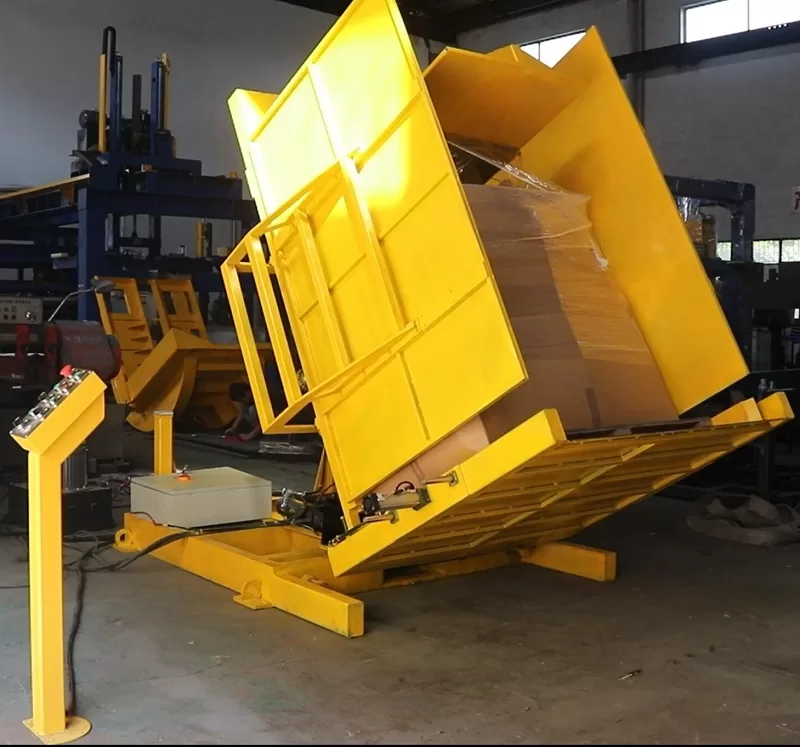
The true load capacity refers to the maximum weight the inverter can safely lift and rotate, while stability is determined by its structural design, base footprint, and clamping system. You must select a machine whose rated capacity exceeds your heaviest typical load, and whose design ensures zero tipping or shifting during the inversion cycle. (industrial pallet inverter load capacity and stability)
🔍 Diving Deeper: Beyond the Brochure Spec
Don't just look at the maximum number on the brochure. You need to understand the operational capacity under real-world conditions.
- Static vs. Dynamic Load: A machine might hold a 5-ton load statically, but can it smoothly rotate that weight? The dynamic forces during movement are different. Always ask for the dynamic load capacity or the safe working load for the full inversion cycle.
- Center of Gravity Matters: Not all loads are perfectly balanced cubes. A coil or an unevenly stacked pallet has a shifting center of gravity. A high-quality inverter will have a clamping system that secures the load from all sides, preventing movement. Look for features like:
- Side-shifting clamps that adjust to different pallet sizes.
- Top stabilizers that press down on the load.
- A wide, low-profile base for a lower center of gravity.
- The Pallet Itself: Are you using standard wooden pallets, plastic pallets, or heavy-duty metal skids? The inverter's forks or clamping mechanism must be compatible. Weak forks can splinter wood, while incorrect clamps can damage plastic.
- Real-World Testing: The best manufacturers, like Fengding, don't just design on paper. They build prototypes and test them with various load types. Ask potential suppliers for video evidence of their machine handling loads similar to yours. An inverter that performs flawlessly with a uniform box may struggle with a heavy, dense coil.
Key Question to Ask Your Supplier: "Can you provide a test report or video showing the machine inverting a [specify your load type, e.g., 4-ton steel coil]? What is the safety factor built into your dynamic load rating?"
Choosing a machine with robust capacity and inherent stability is non-negotiable. It's the foundation of safe and efficient operation. (stable pallet handling equipment)
2. How Does Mobility and Power Source Impact Your Factory Workflow?
A "mobile" pallet inverter sounds great in theory, but what does that truly mean for your layout? Is it truly easy to move between production lines, or does it require a dedicated forklift and operator to shuffle it around? Furthermore, how is it powered? A machine tethered to a fixed power outlet defeats the purpose of mobility, while one with limited battery life becomes an operational bottleneck. Your workflow needs flexible, autonomous movement.
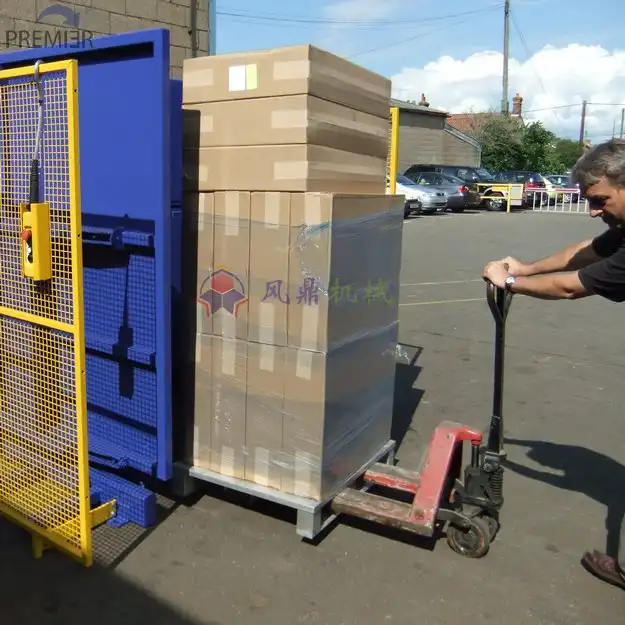
Mobility is defined by the machine's self-propelled capability and maneuverability, while the power source (typically electric battery or diesel/hydraulic) determines its operational range and suitability for different environments (indoor/outdoor). An ideal mobile unit can be easily driven by a single operator to any point-of-need and has sufficient power for a full shift's work. (self-propelled pallet inverter features)
🚛 Evaluating Mobility & Power: A Practical Checklist
Let's structure the decision using a simple comparison. Your choice here will lock you into a specific workflow pattern.
| Feature | Electric Battery-Powered | Diesel/Hydraulic Powered | Key Consideration for You |
|---|---|---|---|
| Mobility | Excellent. Quiet, zero emissions, perfect for indoor use. Often has a compact turn radius. | Good. Powerful, but can be louder, larger, and produce fumes. Best for outdoor/heavy-duty yards. | Where will 95% of your work be? Indoor factory floors demand electric. |
| Power Source | Rechargeable battery packs. Requires charging infrastructure and battery management. | Internal combustion engine. Requires fuel storage and produces exhaust. | What is your facility's infrastructure? Do you have easy access to charging stations? |
| Operational Range | Limited by battery capacity (e.g., 4-8 hours). Needs planned charging breaks. | Virtually unlimited as long as there is fuel. Can work continuously. | What is your shift pattern? Multiple continuous shifts may challenge battery life. |
| Maintenance | Generally lower. Focus on batteries, motors, and electronics. | Higher. Involves engine oil, filters, hydraulic fluid, and more complex mechanics. | What is your in-house maintenance skill set? Electric systems can be simpler. |
| Cost of Operation | Lower "fuel" cost (electricity). Battery replacement is a future capital cost. | Higher ongoing fuel and fluid costs. | Calculate Total Cost of Ownership (TCO), not just purchase price. |
Pro Tip from the Factory Floor: For most manufacturing plants, a robust electric model is the superior choice. Brands like Fengding and Wuxi Bu Hui offer models with quick-swap battery systems. This means you can have a spare battery charging while one is in use, effectively creating 24/7 uptime with no emissions. True mobility means the machine goes to the load, not the other way around, saving immense time in material movement. (electric powered pallet inverter benefits)
3. What Safety Features Are Non-Negotiable?
In an environment like yours, with heavy loads and constant movement, safety isn't a feature—it's the priority. A pallet inverter deals with immense kinetic energy. Without proper safeguards, a simple error can lead to catastrophic injury or fatal crushing incidents. You cannot afford a machine that prioritizes cost-cutting over your team's well-being. The safety systems must be designed to protect the operator from both routine mistakes and unexpected equipment failures.
Non-negotiable safety features include mechanical load locks, emergency stop systems, full guarding, and stability interlocks. These are engineered redundancies that physically prevent the machine from operating unsafely, protecting the operator even if a procedural step is missed or an electronic sensor fails. (pallet inverter safety standards and features)
⚠️ Building a Culture of Safety with Your Equipment
Safety features should work for the operator, not against them. They should be intuitive and robust.
-
Mechanical Load Locks (The Ultimate Backup):
- What it is: A physical bar or pin that engages to hold the rotating frame in place. This is a critical feature. If the hydraulic system were to fail, this lock prevents the load from free-falling.
- Why it matters: Electronics can fail. Hydraulics can leak. A mechanical lock is a simple, physical guarantee. Never purchase a machine without this.
-
Multi-Point Emergency Stops:
- Large, red mushroom buttons should be located at every operator station and around the machine's perimeter. Hitting any one should cut all power to movement functions immediately.
-
Stability and Sequence Interlocks:
- These are smart systems that prevent unsafe actions. For example:
- The machine cannot lift unless the load is properly clamped.
- It cannot rotate unless it is fully lifted and stable.
- It cannot move (if self-propelled) while the load is elevated.
- This eliminates the possibility of an operator accidentally driving a machine with a load in the air.
- These are smart systems that prevent unsafe actions. For example:
-
Full Perimeter Guarding:
- The rotation zone must be completely enclosed by fixed or interlocked gates. If a gate is open, the rotation function must be disabled. This prevents anyone from reaching into the pinch point during operation.
Think Like an Investigator: When evaluating a supplier, ask: "What happens if the main hydraulic hose bursts during rotation?" or "Can you show me the mechanical lock in action?" A reputable company like Fengding will demonstrate these fail-safes proudly, because they understand the real-world consequences. Your goal is to find a partner whose safety philosophy matches your own. (industrial safety equipment for material handling)
4. How Do Durability and Ease of Maintenance Affect Total Cost?
The initial purchase price is just the entry ticket. The real cost of a mobile pallet inverter is spread over its entire service life through maintenance, repairs, and downtime. A cheap machine built with low-grade components might save money upfront, but it will cost you dearly in frequent breakdowns, expensive spare parts, and lost production time. You need a machine built for the long haul, with maintenance designed to be simple and fast.
Durability is determined by the quality of structural materials (high-tensile steel), core components (industrial-grade hydraulics, motors), and protective finishes. Ease of maintenance is defined by accessible service points, modular design, and clear documentation. Together, they minimize unplanned downtime and lower the total cost of ownership over 5-10 years. (durable pallet inverter low maintenance)
🛠️ The Anatomy of a Long-Lasting Machine
Let's look under the hood. Durability isn't an accident; it's the result of deliberate engineering choices.
-
Structural Integrity:
- Frame: Look for a welded frame made from box-section steel, not lighter C-channel. Thicker gauge steel at stress points (like the rotation pivot) is a must.
- Finish: A high-quality powder coat or epoxy paint protects against corrosion, especially important in metalworking environments where dust and moisture are present. Ask about the paint process.
-
Component Quality – The Heart of the Machine:
- Hydraulics: This is the system's lifeblood. Brands like Parker, Bosch Rexroth, or Yuken are industry standards. Avoid machines with no-name hydraulic pumps and valves. Quality here means consistent performance and fewer leaks.
- Electrical Systems: Sealed connectors, organized wiring looms, and reputable PLC (Programmable Logic Controller) brands (e.g., Siemens, Mitsubishi) ensure reliability and easier troubleshooting.
-
Design for Serviceability (This is Crucial):
- Can an engineer easily access the hydraulic valve bank? Are grease points clearly marked and reachable? Are circuit diagrams and parts manuals provided?
- A well-designed machine might have:
- Removable side panels for full access.
- Common tool sizes for all fasteners.
- Modular sub-assemblies (e.g., a complete drive motor unit) that can be swapped out quickly to get the machine running, with the faulty unit repaired off-line.
The Supplier Relationship is Part of Maintenance: A reliable partner provides more than a machine. They provide a detailed maintenance schedule, ready availability of spare parts, and technical support. When I recommend Fengding, it's because their design philosophy incorporates these serviceability principles, knowing that your uptime is your profit. The goal is to move from reactive "break-fix" cycles to proactive, scheduled maintenance that you can plan for. (pallet inverter total cost of ownership analysis)
Conclusion
Selecting the right mobile pallet inverter requires a sharp focus on robust capacity, true mobility, fail-safe engineering, and long-term durability. By prioritizing these features, you invest in a reliable partner that boosts efficiency, ensures safety, and protects your bottom line for years to come. For a machine that embodies these principles, explore the solutions from a trusted Pallet Inverter manufacturer.